
BLOG: Did you know series
Implementing an Order Management System: yes or no?
Rising fulfilment costs. Disjointed systems. Customers expecting a seamless experience across every channel. If any of this sounds familiar, an Order Management System (OMS) could be the solution you’ve been looking for, but is it the right move for your business right now?
All these problems stand in the way of a good customer experience, and that customer experience matters more than ever, because customers have more and more options when it comes to buying and ordering products.
Is Your Retail Operation Showing These Warning Signs?
Before investing in any new technology, it’s worth diagnosing the actual problems. Retailers that benefit most from an OMS implementation typically recognise themselves in several of these common pain points:

High online fulfilment costs
Margins squeezed by inefficient order routing or over-reliance on expensive carriers.
Rigid, hard-to-change systems
Adding a new sales channel or payment method requires months of IT development.
High manual handling costs
Staff time wasted on order exceptions, manual interventions, and system workarounds.
Poor inventory visibility
No real-time, unified view of stock across stores, warehouses, and online channels.
Inconsistent customer experience
Customers can't buy online and return in store, or check real-time stock availability.
Complex, brittle integrations
Point-to-point connections between ERP, WMS and front-end are expensive to maintain.
If you’re nodding along, you’re not alone. These challenges are common across mid-size and enterprise retailers, and they typically stem from the same root cause: no single system owns the order lifecycle end to end.
What Is an Order Management System (OMS)?
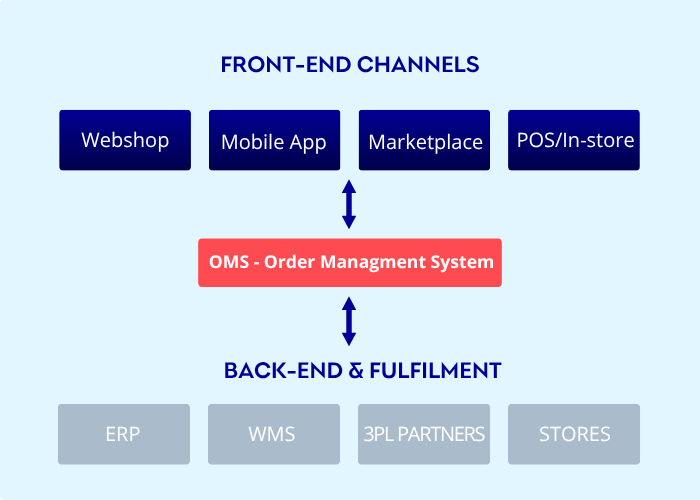
An Order Management System is a dedicated platform that sits at the heart of your retail architecture, managing the full lifecycle of every order, from placement through to fulfilment, delivery and returns, across all your sales channels.
Unlike an ERP, which is optimised for finance and back-office processes, or an eCommerce platform, which is optimised for product discovery and purchase, an OMS is specifically built for one job: orchestrating orders intelligently across your entire operation.
By acting as the central nervous system of your order operations, an OMS decouples your sales channels from your fulfilment infrastructure, giving you the flexibility to change either side without rebuilding everything from scratch.
Why not just use your ERP or eCommerce platform?
Many retailers try to stretch existing systems to handle omnichannel order management. Here’s why this typically falls short:
- ERP systems are too static, built for transactional processing, not real-time order orchestration across dozens of channels. Customising them to distribute omnichannel orders creates technical debt that accumulates with every new channel you add.
- eCommerce platforms are front-end focused: they’re designed to present products and capture orders, not to route, prioritise and fulfil them across a distributed network of warehouses and stores.
- An OMS is purpose-built for order orchestration: it handles the entire post-purchase journey, covering routing rules, stock allocation, payment capture, fulfilment logic, carrier selection, returns management and customer communications.
The business case for implementing an OMS
A well-implemented Order Management System delivers measurable results across four core dimensions:
- Lower fulfilment costs: Intelligent order routing minimises shipping distances and balances stock, cutting carrier and handling costs.
- Higher customer satisfaction: Real-time stock visibility, flexible delivery options and seamless returns build loyalty and repeat purchase.
- Faster time-to-market: Add new channels, payment methods or fulfilment partners in days, not months of IT work.
- Full operational visibility: One source of truth for every order, across every channel, giving operations teams the control they need.
OMS and omnichannel retail: the bigger picture
Implementing an OMS is one of the most impactful steps a retailer can take on the journey to true omnichannel operation, but it’s not the only step. To deliver a genuinely seamless customer experience, your OMS needs to connect with:
- In-store POS systems, so that store stock is visible online, and online orders can be fulfilled from or returned to stores.
- Customer-facing channels: website, app, marketplace and social commerce, providing real-time availability and order status.
- Customer service platforms, giving agents full order history and the ability to take action on any order, from any channel.
When these pieces come together, you create an omnichannel architecture where every system does what it does best, and the OMS ensures they all work in concert.
Is an OMS right for your business right now?
An OMS investment makes the most sense when several of the following are true.
You’re likely ready for an OMS if:
- You sell through two or more channels, such as online, in-store or marketplace
- You’re managing inventory across multiple locations, such as warehouses, stores or 3PLs
- Your current systems can’t support new fulfilment models like ship from store or click and collect
- Fulfilment costs are a growing proportion of your operating costs
- IT changes to your order flow take weeks or months and require significant resource
- Your customer experience is inconsistent across channels
- You’re planning significant channel or market expansion in the next 12 to 24 months
Frequently Asked Questions
FAQs for an OMS implementation
How long does an OMS implementation typically take?
Implementation timescales vary depending on the complexity of your existing systems and the number of integrations required. A focused initial deployment can typically go live within 3 to 6 months, with further capabilities added iteratively. Modern cloud-based OMS solutions like Hardis OMS are designed with pre-built connectors to accelerate delivery.
Will an OMS replace my ERP or eCommerce platform?
No. An OMS complements your existing systems rather than replacing them. It sits between your front-end channels and back-end systems, taking on the order orchestration layer so each system can focus on what it does best.
What’s the difference between an OMS and a WMS?
A Warehouse Management System (WMS) manages the physical processes inside a warehouse: put-away, picking, packing and despatch. An OMS operates at a higher level, deciding where orders should be fulfilled from across your entire network of stores, warehouses and 3PLs, and managing the customer-facing order journey from placement to delivery.
Is an OMS only for large enterprise retailers?
Not at all. While enterprise retailers were early adopters, modern SaaS OMS solutions are now accessible to mid-market retailers too. If you’re operating across multiple channels and fulfilment locations, the ROI case typically stacks up regardless of overall revenue scale.